



Primeiro artigo
Title
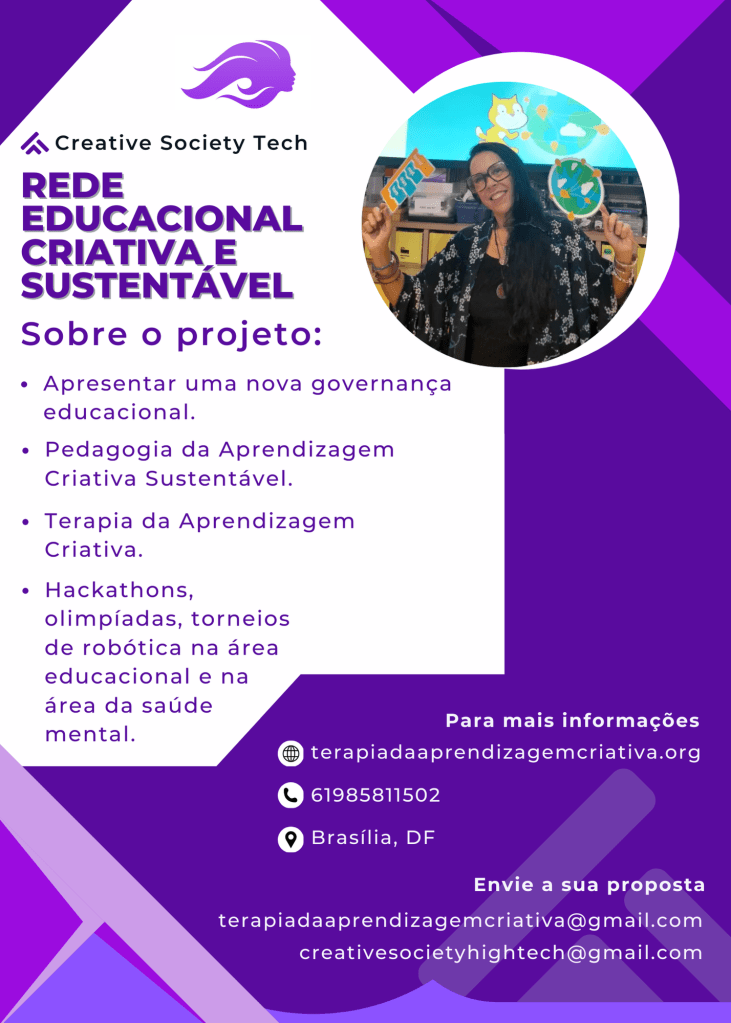
Project: Sustainable School: A new educational governance based on the Pedagogy of Creative Learning and the Therapy of Creative Learning
App: EduNetwork Governance
Name: Claudia Fernandes Nunes de Menezes / Brasília, Brazil / creativesocietytech.com
Abstract
Today man must live in a globallzed world and know how to live with diversity. With the current context in which cities are inserted, is necessary a change in the interactions between teachers and students, within the school universe. In 2023, when I worked and analyzed the universe of the Secretaria Estadual Educação do Distrito Federal(SEEDF), then a reflection emerged on how to build an integrated and shared system in public schools network, through the sharing of work, courses, and projects, using tools of Learning Creative Educational and robotics that promote the exchange of information, mental health and new learning in the school community or in other similar networks, such as hospitals. Thus, a new educational governance emerged with different approaches within education and the therapeutic world, focused on the premises of the Common national curriculum base(BNCC) and the Sustainable development goals (SDGs).
Index Terms – Creative Learning; robotic; exchange; sharing, governance.
Introduction
This new approach emerged from experiences gained in therapy, school, university, and the technological world, through reflections and studies on what belongs to the SELF, the OTHER, and the SOCIAL. Thus, initiating reflections on various social situations that affect social relations and the individuation of the person is an objective of this project, with the main goal of addressing the Sustainable Development Goals (SDGs).
Methodology
The main question of this project is to discover the reasons for this epidemic that causes social discomfort (issues discussed in the book by Sigmund Freud). How can we solve this equation on a large scale that the current structure is unable to resolve the emergencies of a world in destruction and inequality? We know that when a person has self·knowledge professional and personal, these factors can reflect in their mental and physical health, thus developing people with happier and healthier lives. But what is the problem->solution equation that could promote the end or alleviate social discomfort? Thus, this project emerged in response to the current chaos that the world and people are experiencing in the environment, in society, and in individual life.
The Sustainable School in a network has similar principles and is applied on external platforms, such as Scratch, the book “Lifelong Kindergarten” within the school, and projects applied in models of Brazil Robotics Tournament (TBR). These can help facilitate the transition and integration of students and teachers into the digital world in a future career in a creative, conscious, and sustainable way. Moreover, they would respect the copyrights of projects built by teachers and students, protecting brilliant minds from the fierce competition of big companies or ill-intentioned groups that often erase great potential to maintain the concentration of power In the hands of a minority. This approach allows the school to avoid the departure of teachers and students, encouraging other students to be more motivated to build their own path and career through good examples and strong references.
The pedagogy of sustainable creative learning focuses on inserting students into the world of technology, entrepreneurship, sustainable culture, and research, so that students become the protagonists of their own school and professional lives in a more conscious way developing creativity, skills, competencies, and autonomy in thinking and making choices, with an emphasis on the SELF, the OTHER, and the SOCIAL.
The three pillars blend together, and through this learning, we can create a culture focused on the pursuit of self-care, environmental care, respect for diversity, inclusion, and combating bullying that leads to suicide, racism, slavery, addiction, and other social ills. These behaviors will be learned during the educational journey of both the student and the teacher, where both learn to break free from distorted values implanted in the collective unconscious to focus on the pursuit of an individual life purpose, which can expand to the social sphere, achieving self-realization as a person and as a professional, through balanced and healthy relationships. In fact, the school teaches students to follow a predetermined social script from birth, and the goal is to break with these patterns through the conscious choices that education can promote in the lives of students as active people and authors of their own stories, with knowledge being the key to developing potential, creativity, and independence.
Education should encourage students to discover their life purpose, values, true awareness, and self-knowledge through the development of skills and competencies built in everyday life, and not just content to be memorized to pass college entrance exams or other selection processes. The world is full of shared information, both inside and outside schools, but people continue to cultivate inadequate behaviors, values, and learning because they are unable to absorb and learn what they have read, watched, or heard. It is necessary to encourage an education and pedagogy, using platforms, that inspires students to build their own knowledge and apply it to daily life. This approach should involve students in groups or life projects that share common goals, promoting reflection on the processes of construction and deconstruction of their own lives and the environment. So, studies show that a platform for sharing projects within a network with stories, quizzes, tutorials, and many other activities, can provide an environment that engages the school community. A good example of this is Maho Ashley (Scratch, 2024), who created over 200 projects in various formats on Scratch during one year of use cultivating the four Ps of creative learning (Resnick. 2020).
With so many inspiring examples, the idea emerged to create a project that could be based on the architecture of Scratch and abstract the main concept of Scratch, which is the sharing of projects, beyond of developing programming activities, documents or projects with social purposes that approach the “Scientific Merit”, “Organization and Methods” and ”Technology and Engineering” of a given subject selected by the students and connected to a Sustainable Development Goal(SDG), promoting an environment of social exchange and shared knowledge, within the reality of each school with your own adaptations. It is important to highlight the encouragement of a culture of respect adopted by the Scratch community, through the establishment of Community Guidelines, such as: be respectful, be constructive, be honest and help maintain the friendly atmosphere of the site. If a student does not follow the guidelines or school rules, it is necessary to inform that the responsible person would make appropriate learning or behavioral interventions with the help of the school community. This sharing of projects and activities can be built on a platform with screens that manage therapies, projects and activities (based on the Designer Think methodology, Kanban, Project-Based Learning), Green Popular Music (music created by students and professionals about construction and the environment), mentoring, tutoring, creative clubs, through a new approach called Pedagogy of Sustainable Creative Learning, Creative Learning Therapy and its ramifications (Creative and Sustainable Learning Bibliotherapy, Creative and Sustainable Learning Art Therapy, Creative and Sustainable Learning Music Therapy, and Creative and Sustainable Learning Physicotherapy), with the support of researchers from universities and the school community for the realization of projects, within a closed institutional network to maintain the physical and psychological safety of the school community against aggressive and exclusionary people or groups. It is important to emphasize that all these approaches utilize a spiral of creative learning that is adapted according to the approach created, whether pedagogical or therapeutic.
Given this context, how can we engage these young people in meaningful projects throughout their educational journey? The solution would be to develop these projects within schools, from elementary to higher education, using the model of the Brazil Robotics Tournament and spreading these projects across school networks, hospitals, and other entities that require research and information sharing, promoting the exchange of knowledge, solutions, and projects that align with the Sustainable Development Goals.
In today’s world, it Is evident that government and civil interventions can’t resolve large scale environmental emergencies that the world has faced. So, why not include the school and promote this acceleration of changes throughout our ecosystem? Thus, It Is important to show that the basic and higher education can encourage sustainable education, promoting this self-discovery through experiences like hackathons, tournaments, olympiads, volunteer work, project development and other parallel activities that engage students in their areas of interest but without encouraging wild competition, through the search to discover the points strong and weak that can improve and promote self-knowledge and insertion of students in their areas of Interest. The development of educational and therapeutic projects within basic and higher education can be or can not be your discovery of a conscious, healthy, and happy career, through construction, reflection, and Imagination as demonstrated in the learning spiral by Mitchel Resnick.
Result and conclusion
The project is under construction because it is innovative and uses the creative learning methodology, but we have real-world examples of platforms, Robotics tournaments or the use of creativity in therapy, such as App Inventor and Scratch.
We concluded that it is necessary to maintain the culture and values of creative learning, among other aspects such as maker culture and robotics, within a closed educational network.
Segundo Artigo
TITLE
Project: Importance of a new approach in therapy: An innovative approach called Creative Learning therapy / AppInventor: EduNetwork Governance
Name: Claudia Fernandes Nunes de Menezes
Brasília, Brazil/ creativesocietytech.com
ABSTRACT
With the changes in the world and the integration of technology in all sectors of society, the importance of a new approach called “Creative Learning Therapy” has emerged, due to the knowledge accumulated throughout my professional career. The research began with the Creative Learning Residency in Bahia, realizing ideas that were still without references, but based on interdisciplinary areas such as education, psychology, and technology. This approach is part of the project “Sustainable School: a new educational governance in a network based on the Pedagogy of Creative and Sustainable Learning, Creative Learning Therapy and its ramifications” and the EduNetwork Governance application, developed in App Inventor.
Keywords – Creative Learning, Sustainability, Creative Learning Therapy, Scratch, Robotics.
INTRODUCTION
The objective of this project is to research and apply an innovative approach that integrates interdisciplinary knowledge and practices. Thus, this project represents the beginning of the development of a new therapeutic approach that aims to develop and achieve the Sustainable Development Goals (SDGs). Creative learning therapy has given rise to new therapeutic branches, which is an innovative and emerging factor of the Sustainable School project, maintaining the creative learning methodology as a main reference to be followed in all parts of the project.
METHODOLOGY
According to educators and scholars from various fields, the concept of “learning by doing” is fundamental as learning. In Creative Learning, lhis “doing something” involves hands-on activities based on imagining, creating ideas, transforming them into actions, interacting with and experimenting on these ideas, sharing them with the therapist, family, or the school community (depending on the patient’s profile, confidentiality, and context), and reflecting on the strategy as a learning process that may or may not be revisited in methodology of Creative Leaming spiral, as such as creating a “fear” monster from scrap materials like cardboard, milk cartons, colored pencils, markers, etc. When the patient or student finishes the scrap activity, he/she can create a story of confronting and reconciling with their fear, and continue the therapy with the creation of a Bullet Journal to organize and plan routines, ideas, goals, project developments (fear project), and challenges overcome in therapy or daily life.
The project will include activities and interventions that search reflection on the activity, the interventions, the experimentation, or the playfulness, which may be shared with peers, family, and therapists for the patient or student to reflect on the positive and negative aspects of their practice. The project could be redefined with new reflections and strategies when the patient or student needs changes or reflections.
When the therapist proposes the creation of a “fear” monster using scrap materials, different interventions may be applied, asking the patient or student to build their own imagined character, going through the same process as creating the “fear”monster. According to academic references, Role-Playing Games (RPG) are commonly used with existing board games. The difference with the hand-on RPG therapy game, which incorporates Creative Leaming principles and Scratch, is that it allows the patient or student to create their own story, challenge, or adventure based on their selected therapeutic project.
Throughout therapy, the therapist may introduce the use of the RPG game of emotions. Initially, the patient must fill out a character sheet with details about the character and the emotion or behavior they want to address as the theme of their project. In the early sessions, the therapist explains the game to the patient or student, guiding them in filling out their character’s details: the fictional name, game objective (confronting fear), character creation, imagining the scenario, and completing psychological, physical, and skills characteristics. The therapist helps the patient or student select the scenario for building the project, asking to imagine the scenario, instructions, challenges, strategies, problem-solving, and skills developed in confronting their fear. The strategies may be modified based on the patient’s needs and the group dynamics.
At the end of the therapy sessions dealing with fear in the RPG, the therapist may suggest an intervention for the patient to reconcile with their “fear” monster, choosing a doll or robot as their companion in overcoming daily challenges. This process helps the patient view fear as a tool for growth to become a stronger and better person, proposed by Mitchel Resnick. In Creative learning therapy, the objective is on analysis, interventions, confronting, or experimenting with new behaviors that could potentially resolve pain or problems.
In Creative Leaming, projects are encouraged so that children or adolescents can create their own interactive stories, games and animations starting with ideas and transforming them as projects that can be shared with others. The approach to projects within therapy can vary depending on the environment, can be into the school or clinical, but preserving professional ethics and the privacy of personal information. In clinical individual therapy, whether in therapy each demand or problem that a patient wants to treat, this can be a project to be developed within the therapeutic process, according to the patient’s age and profile. In school therapy, the therapist may survey the most common school demands and propose group projects, with the assistance of the creative therapist, using tools available within the school, but focused on the world of Creative Learning. The creative therapist can develop new skills and new roles as a catalyst, consultant (mentor), connector, and collaborator.
For Creative Learning, the spiral is a concept that aids in the development of creative thinking. According to the book by Mitchel Resnick, the spiral of creative learning begins in kindergarten, where children, adolescents, and even adults can develop and enhance their abilities as creative thinkers by developing and learning from their own ideas, feelings, emotions, and actions. They can also test and experiment with new solutions in interactions with others opinions, evaluate, renect, imagine new ideas, and create new behaviors based on their daily experiences.
However, the Creative Learning spiral is rarely stimulated in schools and in society, but the Creative Learning Therapy is an approach against the standardization imposed by society, aiming to develop the individualization of the self, potential and socio-emotional skills on the way creatively, within the digital universe.
The patient’s objective in therapy will be linked to the area of interest they wish to explore, beyond focusing on your area of interest using playful tools that promote reflection and creativity to create.
The patient or student can share their project with the therapist, at the clinic, school, or within the family, as they desire, showing their process of change. In the school, the therapeutic group can share their learnings and reflections with their classmates who are suffering from the same challenges, pain, or struggles, fostering empathy and the development of competencies and socio-emotional skills within the methodology of creative learning that follows the premises of the National Common Curriculum Base and the Sustainable Development Goals(SGDs).
The origins of Robotics Tournaments and Olympics began with the educational projects of Mitchel Resnick, but we can raise some questions: Why is it important to have tournaments within institutions? The main objective is to stimulate innovation, creativity, respect for other people’s projects, teamwork and inclusion, development of digital, emotional, and intellectual skills and creation of competencies used in National Commom Curricular Base(BNCC) and in SGDs.
Beyond the Creative Learning therapist promoting mental health within clinics, hospitals, schools, or institutions, Creative Learning Therapy could also organize Robotics Tournaments, Olympics, or hackathons in the field of mental health. Activities in Scratch or AppInventor, involving storytelling or game creation, and projects with scrap can be done in pairs to start discussion and collaborative solutions to the project’s challenge promoting behavioral change for both individuals and their friends.
The project could involve programming and gamification to teach concepts related to emotions, possibly drawing inspiration from the movie Inside Out. The therapist can program an RPG in Scratch for confronting emotions or stimulate the patient or student to create their own game and challenge. Scratch activities can be done in therapy or in pairs at school to start a discussion and reflection on the project’s topic, enabling new interventions, reflections, and practices, in a new environmental adaptation.
The creative learning therapy approach has evolved and branched out into other kind of therapies, such as Creative and Sustainable Learning Bibliotherapy, Creative and Sustainable Learning Art Therapy, Creative and Sustainable Learning Music Therapy, and Creative and Sustainable Learning Physicotherapy. These kind of therapies belong to the EduNetwork Governance app and the “Sustainable School” project, which can be selected by students or the school community.
RESULTS AND CONCLUSION
These approaches are under construction, with some practices already in place, due to their innovative nature.
Therefore, it is important to apply these approaches within institutions or clinics because they promote reflections required by the Sustainable Development Goals and the National Common Curricular Base through creativity, utilizing different spirals of creative learning as a methodology adopted for each therapeutic approach using the EduNetwork Governance app that is a modern educational frameworks.